








Post-merger integration: How to set your new, integrated Business Unit up for success with your top 50 Leaders — and beat the odds?
The Human and Business Challenges of Integration
Our client, Managing Director of a Business Unit within a global group, had aligned with the Group CEO on four major ambitions:
- Integrate the merged organisations into a global specialist Business Unit, leader in its field
- Catch up on integration delays caused by transaction complexity
- Deliver significant growth and synergies
- Contribute meaningfully to the Group’s sustainable transition ambitions
The human challenge was considerable:
- Two former competitors brought together within one global company
- A delayed integration process
- Very limited understanding of each other’s operating models
- Significant cultural differences with teams across five continents
- A dynamic of mistrust starting to take root
During interviews, leaders expressed both hope and fear:
- “We could achieve so much together… but I worry the others won’t really play the game.”
- “As the acquired entity, I’m afraid we’ll be absorbed — that decisions and opportunities will all be funnelled to the acquiring organisation.”
This is not an isolated case : 60–80% of mergers fail to deliver the promised value.
We hope for 1+1 >> 2… but too often, we get 1+1 < 2.
Beating the Odds Starts with the Human Factor
What this project confirmed — once again : Successful post-merger integration starts with the human factor – well before the org chart, the synergy targets, and the roadmap.
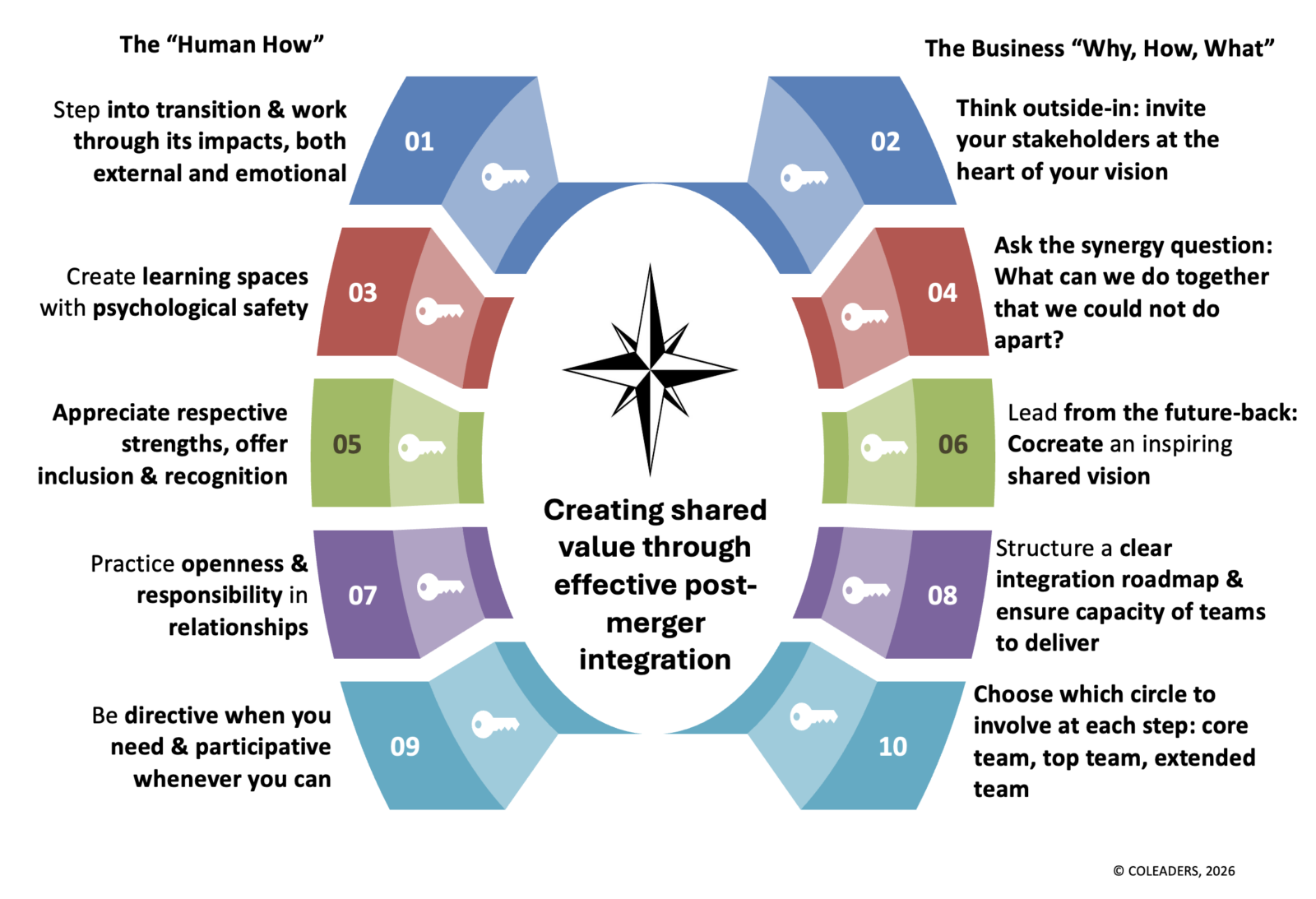
In our experience, five “Human How” keys are indispensable.
- Stepping fully into the transition, and working through its operational and emotional impacts
- Creating genuine learning spaces with psychological safety
- Appreciating respective strengths, fostering recognition and inclusion
- Practicing openness and co-responsibility in relationships
- Being directive when necessary — and participative whenever possible
These five keys are necessary – but not sufficient.
Integration success also requires 5 keys on the business side:
- Thinking outside-in, placing clients and stakeholders at the centre
- Asking the synergy question:
“What can we do together that we could not do apart?” - Leading from the future-back by co-creating a compelling shared vision
- Structuring a clear integration roadmap with defined workstreams
- Ensuring teams truly have the capacity to deliver
These 5+5 keys informed our approach for the six-month coaching journey with the new team, culminating in a 2.5-day seminar bringing together the 50 top leaders.
Our coaching was also grounded in our participative transformation approach, which made a very tangible difference in practice:
- Define the strategic question that mobilises all stakeholders
- Involve stakeholders and teams early
- Facilitate the group to foster collective intelligence
- Engage head, heart and values
- Amplify what already works — AND address the real issues
- Co-create an inspiring vision of the future
- Combine impactful action with deep learning and unlearning
- Elicit voluntary commitment for action
“People don’t resist change. They resist being changed.” Peter Senge
Our coaching approach
The overall project ambition was clear:
Together, create the conditions for success of our new integrated Business Unit — and achieve what we could not accomplish separately.
We still needed to articulate the specific goals of the coaching. We clarified them with our client along two main lines:
“Human How” Goals for Integration
- Getting to know one another
- Strengthening relationships and trust
- Taking stock of the transition and its impact on us
- Taking ownership of our new identity and strategic vision
- Developing our own capacity to lead this new identity and strategic vision
- Preparing to embark our teams and stakeholders
Business (“What”) Goals for Integration
- Understanding respective activities to build on our combined DNA at our best
- Clarifying the new organisation
- Co-creating a compelling shared vision
- Building the operating model and action roadmap
- Identifying and planning key integration workstreams
We then co-designed a structured, three-phase journey.
Phase 1 – Initial Teaming with top team members across the 3 organisations
- Coaching sessions with the sponsor
- Individual interviews with 15 representatives from 3 organisations
- A 2-day integration seminar with the 15 representatives
Phase 2 – Developing the Shared Vision with the core team
- Five half-day sessions to co-create the shared vision with the core team of 4 representatives
- Ongoing coaching sessions with the sponsor
Phase 3 – Engaging the Top 50 Leaders
- Half-day session with the newly formed executive team
- A 2.5-day immersive seminar with the Top 50 leaders
- Continued coaching sessions with the sponsor
The Top 50 Leaders Seminar
The Top 50 Seminar was the culmination of the coaching journey.
Our coaching challenge was to get the group on board and involved in the process, even though they had significant concerns and doubts about the integration. Right up until the dinner the night before the seminar started, some participants from the acquired organisation told me about their mistrust and fear of being the losers in the integration, of not having a say in the new company.
“As the acquired entity, I’m afraid we’ll be absorbed — that decisions and opportunities will all be funnelled to the acquiring organisation.” Executive participating in the 50 Leaders workshop
Creating safety and engagement required a carefully structured agenda and facilitation rooted in our participative transformation approach.
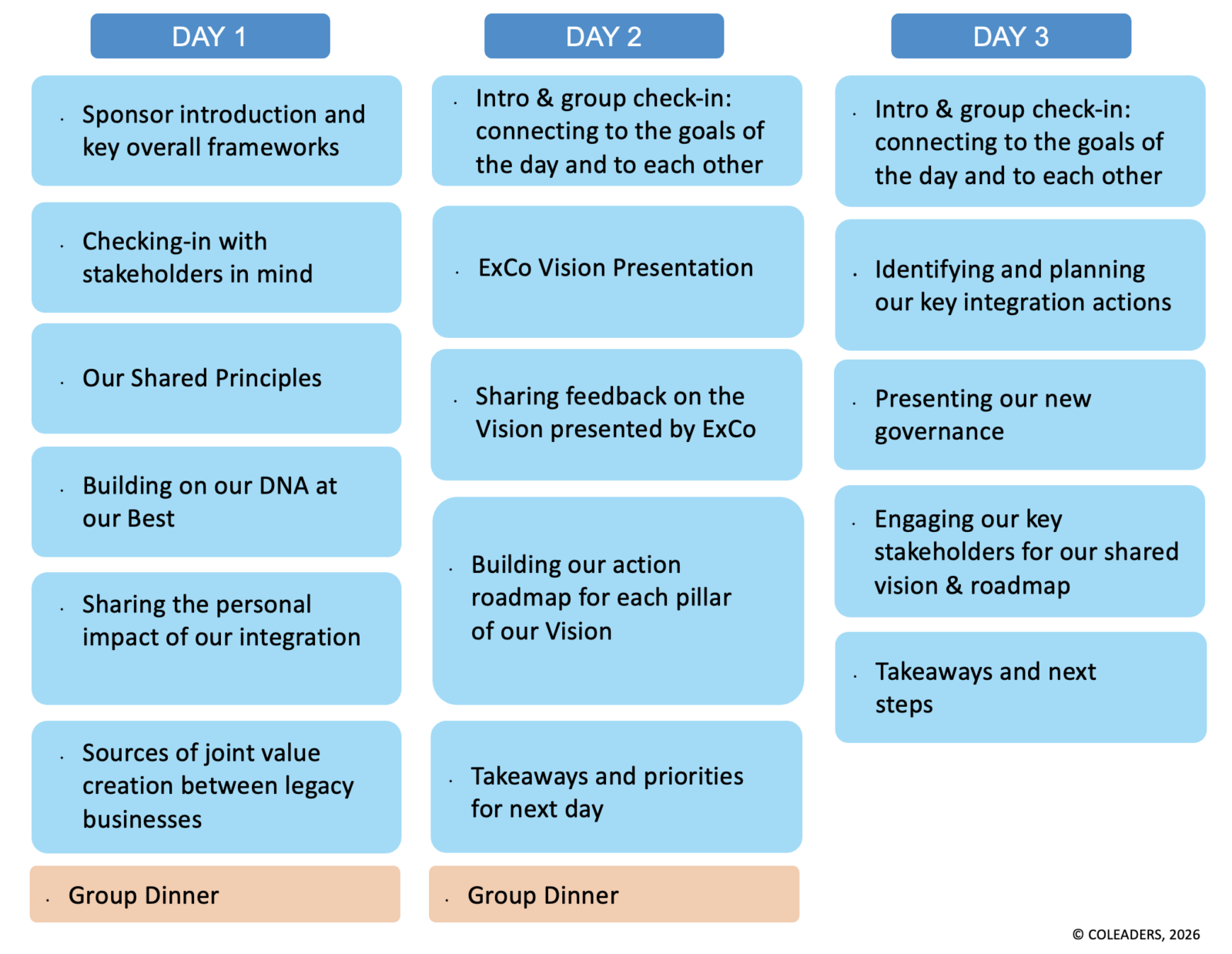
This fostered a spirit of openness and engagement within the group throughout the three days.
The highlights during the Seminar included:
- Day 1 Morning. Sharing inspiring success stories from each legacy organisation in mixed groups — reconnecting with each entity’s “DNA at its best.”
- Day 1 Afternoon. Naming very openly the emotional impacts of the integration — first in legacy groups, then in plenary.
- Day 2 Morning. Full ExCo presentation of the shared vision, followed by open dialogue in mixed sub-groups then in plenary on the emotional impact of the vision: What inspires us? What raises doubts? What do we need in order to commit?
- Day 2 Afternoon. Co-creation of the roadmap across five vision pillars in a dynamic World Café format.
- Day 3 Morning. Collective intelligence session to identify key integration workstreams and cocreate stakeholder engagement plan.
- Each evening: informal group dinners — strengthening connections outside of working sessions.
Energizing outcomes and benefits
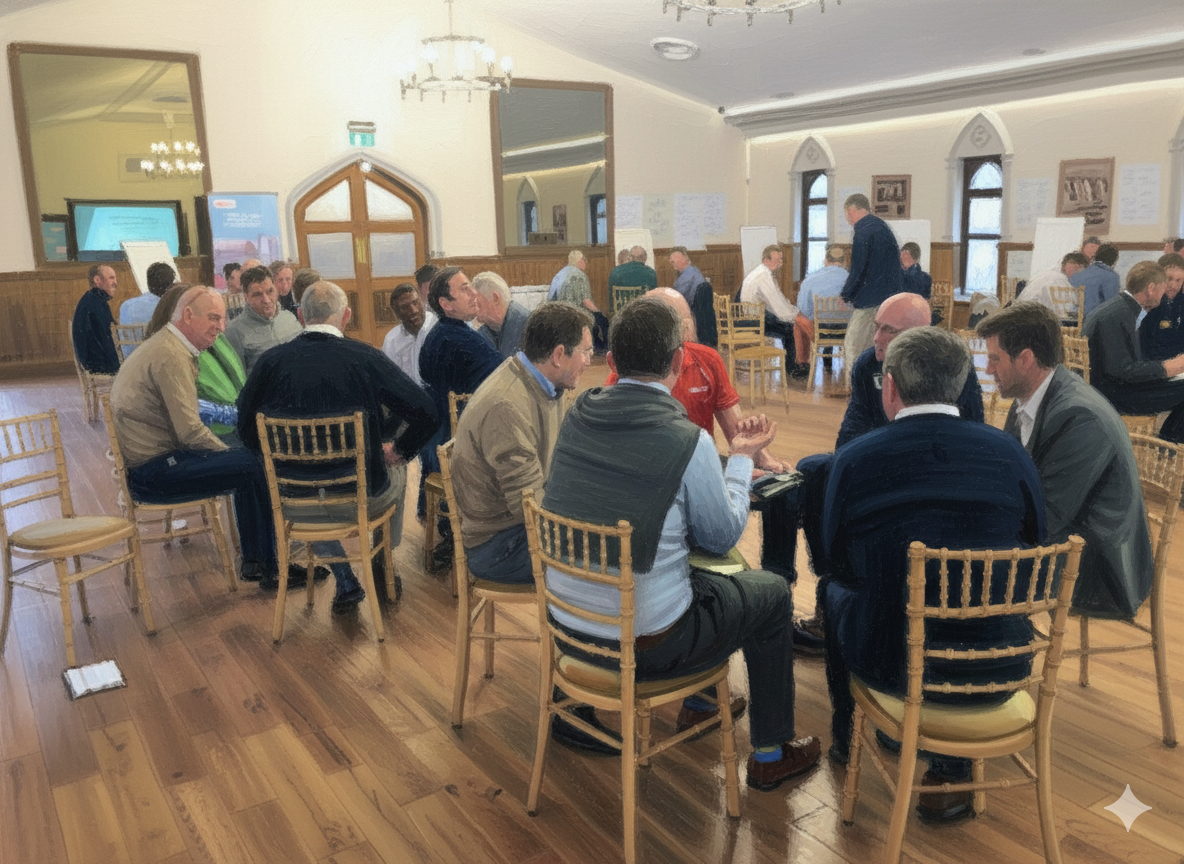
The group left with greater cohesion, emerging confidence, genuine ownership of the vision — and a concrete roadmap for implementation and stakeholder engagement.
Human factor outcomes
- Stronger relationships and emerging trust
- Key merger concerns surfaced and addressed
- Emotional transition “in progress” (endings / continuity / new beginnings)
- Shared ownership of identity and strategy
- Commitment to action
- Readiness to act as ambassadors to embark teams and stakeholders
Business Outcomes
- Shared understanding of activities and offerings
- A cocreated sense of our “DNA at our best”
- Clarity on the new organisation
- Understanding of and commitment to the shared vision
- A co-created roadmap to deliver key ambitions
- Identified integration workstreams with a clear roadmap
- A stakeholder communication plan
Testimonies from Participants
At the end of each of our seminars, we ask for open feedback from the entire group. At the end of the seminar with the 50 leaders, they particularly appreciated:
- Psychological safety and open dialogue. “Honest engagement, secure environment.” “Open exchanges and dynamics.” “Structure and openness.”
- An approach that brings down barriers quickly. “The approach broke down barriers very quickly.” “The sequence and structure of the workshop.” “The facilitators’ ability to guide the discussions safely and effectively.”
- Clarity and direction “Clarity.” “Structured facilitation.” “Clear direction of topics, questions and activities.”
- Strong group engagement “We all came onto the same page.” “Excellent group dynamics.” “Engagement of everyone.”
I would like to thank our clients for their trust, as well as my colleague Paul Boursier for his valuable contribution to our thinking in this project.